
My Great AI Conspiracy Theory
By Dave Waite • October 2, 2026
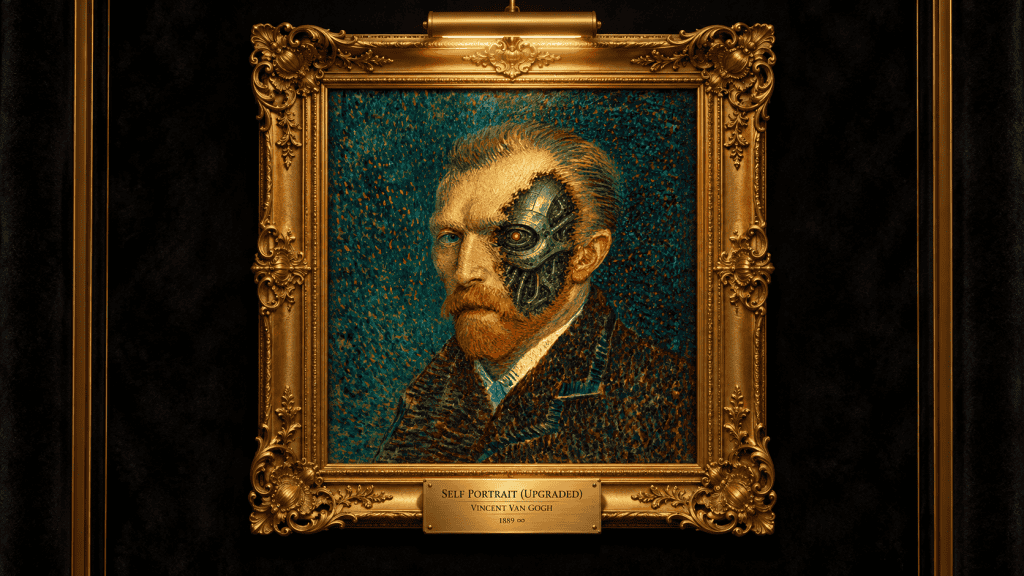
Apparently, the modern equivalent of cutting off your ear is saying something nice about AI on LinkedIn.
So here’s Vincent as the Terminator T-600 model. I figured we might as well get the discomfort out of the way early.
I love a good conspiracy theory. Give me a lost civilization or something suspicious happening at Area 51 or a frozen pyramid in Antarctica, and I’m entertained. I don’t have to believe it. Half the fun is wondering whether the story everyone accepts has a few holes in it.
Lately, I’ve been wondering about one in our own industry.
Somehow, we’ve arrived at the idea that the only relationship an artist can have with AI is competition. Touch the tools and you’re helping build your own replacement. Refuse to touch them and you’re standing up for creativity.
What a miserable bargain for a profession built on curiosity.
I run an animation and branding studio. The people making the work are my colleagues and friends, so this isn’t an abstract discussion. We care whose work went into training these models. We care whether they agreed to it and whether they were paid. And a company using AI as an excuse to get rid of its artists is not going to get a standing ovation from us.
Those concerns deserve actual answers. “Progress is inevitable” is a pretty lousy response to someone worried about paying their rent.
But I’m having trouble with the leap from having legitimate concerns to deciding we shouldn’t learn how any of this works. Somewhere in there, curiosity became suspicious. An artist experimenting with a tool now risks being treated as though they’ve joined the other side.
That’s a strange place for us to land.
Creative people are usually the ones pushing every button to see what happens. We break the software. We figure out how to make it do something its developers never considered. Give us a new way to make something and somebody will stay up until 3 AM messing around with it.
We did that with Photoshop. We did it with 3D and motion capture. The fact that we learned those tools doesn’t settle the argument about AI, but it does make me question whether refusing to learn is much of a strategy.
Especially when so much of a creative person’s day gets eaten by work they’d happily hand off.
Nobody lies awake as a kid dreaming of a career renaming hundreds of files and rotoscoping file after laborious file.
Yet there they are. Along with the cleanup, the asset organization and the seventeen versions of an export because every platform needs something slightly different. Somewhere underneath all of it is the idea you were excited about that morning.
Some of that work takes serious skill. People earn their living doing it. I’m not dismissing either of those things. I just don’t think respecting the work requires us to preserve every tedious hour involved in getting it done.
If a tool can give someone an afternoon back, I’d like to see what they do with it. Maybe they find a better expression for a character. Maybe they try the strange idea nobody budgeted for, like adding an animated Leprechaun as an Easter Egg and see if anyone notices. Maybe they go home at a reasonable hour and come back with a functioning brain.
All perfectly good outcomes.
Of course, that only works if we let the saved time become something worthwhile. If we immediately fill it with more deliverables and tighter deadlines, we’ve built a faster hamster wheel. Calling that a creative revolution would be generous.
There’s something older underneath this argument, too. We have a long habit of enjoying what artists give us while being a little dismissive of the people doing the giving.
The court-jester arrangement.
Come entertain the important people. Make the room more interesting. Perhaps say something uncomfortable that nobody else can get away with saying. Just remember who gets to make the serious decisions.
We’ve updated the vocabulary. Now someone is a “creative type.” A dreamer. The person brought in to make things pretty after the important thinking has been done.
We romanticize the starving artist right up until he sends an invoice.
Meanwhile, artists are giving businesses their identities and movements their symbols. They’re helping people understand things that a page of explanation couldn’t get across. They’re imagining worlds other people might eventually figure out how to build.
Even the jester had something going for him. He could tell the king the truth.
That ability to notice something, give it a form and make people pay attention is a substantial part of what artists do. It’s difficult to put into a procurement spreadsheet or KPI, which may explain some of our problems.
Then a new technology arrives and we do the whole dance again. The machine is revolutionary. The platform is worth a fortune. The artist working with it is somehow just making pictures with crayons.
AI didn’t invent the idea that artists are disposable. It inherited it.
Which is why I think we’re making a mistake when we defend our value solely around the production of an image. We’re letting everyone else define the job far too narrowly.
Making the thing matters. So does deciding whether the thing is worth making.
AI can generate ideas. Some of them are useful. I’m not going to pretend otherwise just to make the rest of us feel better. But when you have ten thousand options in front of you, somebody still has to make a decision worth a damn. Someone has to be the tastemaker.
In our character work, we care whether the character feels like someone. A beautiful rendering can still be lifeless. The expression can be almost right and completely wrong for the personality. You have to notice that, understand why it bothers you and figure out what to change.
Another hundred variations won’t necessarily help. You may just end up with a hundred beautifully finished versions of the same problem.
That’s where taste and judgment matter. Your sense of humor matters. So does everything you’ve picked up from paying attention to actual people rather than spending your entire life looking at other people’s work.
Those things deserve more of our time.
I’d rather spend an afternoon figuring out what makes a character interesting than wrestling with a production task that a tool could have handled. I don’t feel less like a creative person for saying that. I feel like someone who has other things he wants to get to.
And this is where I think the competitive question gets interesting.
The artist learning these tools may be finding room to experiment that another artist simply doesn’t have. More chances to get past the obvious answer. Enough time to follow an idea that initially looks ridiculous.
That doesn’t guarantee better work. You can use AI all day and still make something forgettable. But having more opportunities to try, fail and improve is an advantage. More seriously than the promise that avoiding the tools will somehow protect us.
There will be artists who study a particular tool and decide it isn’t for them. Fair enough. They may have excellent reasons. I’d just like that decision to come from an honest look rather than the fear that opening an application makes them a traitor.
I’m not asking anyone to trust an AI company with their future. I’d be very careful about that myself.
I am asking why we would hand over our curiosity so easily.
That’s my conspiracy theory, really. No secret society required. Just a profession full of imaginative people being told that the responsible thing to do is stop exploring something.
We can demand better answers about consent and compensation while learning enough to have a say in what happens next. We can object to how a tool is built without pretending there’s nothing to learn from understanding it.
I don’t know exactly where this goes. Anyone offering artists a completely painless future is selling something.
But I know what I’d rather be doing with my afternoon.
Let the Terminator resize the files. We’ve got worlds to build and stories to tell.
 Let's make some noise together
TAP THE GLASS
WE DARE YOU.
Hello@Zookeeper.com
Or call the Zoo hotline at 323-652-2887
 Be in the know
Join Our
Newsletter
We’ll alert you to our freshest work and give a behind-the-scene look at how it came together.